

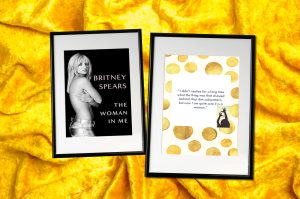
The Woman in Me by Britney Spears is the exact same story as “The Yellow Wallpaper” by Charlotte Perkins Gilman.
Okay. Maybe they’re not EXACTLY the same. But we can’t ignore the similarities.
Britney Spears recently released her memoir, “The Woman in Me” and I listened to it on audio (Michelle Williams does an excellent job narrating). It’s all about Spears’s personal journey and struggle for autonomy and freedom. Similarly, Charlotte Perkins Gilman’s 1892 short story, “The Yellow Wallpaper,” explores a woman’s quest for self-expression and independence, while being restrained by societal expectations and patriarchal control. You’ d think two works released over 100 years apart wouldn’t have so much in common–that society would have changed enough that women couldn’t so easily be oppressed.
Nope!
Both works highlight the damaging effects of society’s treatment of women and their bodies, and the parallels are striking.
The quotes from “The Yellow Wallpaper” by Gilman, show the protagonist’s struggles with mental and emotional distress, as she is confined to a room with yellow wallpaper by her husband and doctor. She is not allowed to write or do anything but “rest”, which only adds to her deteriorating mental state. She is constantly gaslighted and belittled, with her husband insisting that there is nothing wrong with her and that she should just rest and be a dutiful wife. This parallels the experience of Britney Spears, who was also under strict control and surveillance by her family and management. She was constantly criticized and judged for her appearance, her choices, and her actions, and her autonomy was severely restricted. When her father made her go to rehab for using over-the-counter energy supplements, the “treatment” threatened her sanity.
In “The Yellow Wallpaper,” the protagonist’s husband, John, dismisses her suffering and insists that has temporary nervous depression. He believes that her condition can be cured by rest and isolation, and that she should not engage in any intellectual activity. Similarly, Spears’ family and management dismissed her struggles with mental health, insisting that she was just causing trouble and seeking attention. They controlled her every move, from her career to her personal life, and even forced her to continue working and performing despite her mental and emotional distress. In both cases, the women’s voices were silenced and their agency was taken away, as they were not seen as capable or deserving of making decisions for themselves.
Gilman’s protagonist also mentions how the yellow wallpaper in her room seems to move and take on different shapes. She believes that there is a woman trapped behind the pattern, trying to escape. This can be interpreted as a metaphor for the societal expectations and restrictions placed upon women, as well as the woman’s inner desires and struggles for freedom. Britney Spears went through something very similar in the 21st century, and she gave up her freedom so she could keep seeing her children.
Moreover, both Gilman’s protagonist and Spears’ personal experiences shed light on the damaging effects of society’s obsession with women’s bodies. In “The Yellow Wallpaper,” the protagonist is constantly reminded of her supposed “hysteria” and is told that she must rest and not engage in any physical activity. This reflects the idea that women’s bodies are fragile and must be controlled and protected by men. Similarly, Spears’ body was constantly scrutinized and judged by the media and her own family. In her memoir, she reveals how she was forced to undergo grueling workouts and strict diets, and was also pressured to maintain a certain image and sexual appeal. This objectification of her body not only took a toll on her physical health but also on her mental and emotional well-being.
Another parallel between the two works is the idea of women being reduced to mere objects or symbols, rather than being seen as individuals with their own desires and agency. In “The Yellow Wallpaper,” the protagonist is not even given a name and is referred to as “the woman” or “the lady in the wallpaper.” She is seen as a possession to be controlled and managed, rather than a person with her own thoughts and feelings. Similarly, Spears’ image was heavily controlled and marketed by her management and family. She was often used as a symbol of sexuality and rebellion, without her own consent or agency. This dehumanization and objectification of women’s bodies and identities is a recurring issue in society, and both “The Yellow Wallpaper” and “The Woman in Me” bring attention to it.
But don’t take my word for it. Check out some select quotes from both the short story and the memoir, and tell me if you don’t see the connections.
“The magazines seemed to love nothing more than a photo they could run with the headline “Britney Spears got HUGE! Look, she’s not wearing makeup!” As if those two things were some kind of a sin—as if gaining weight was something unkind I’d done to them personally, a betrayal.”
― Britney Spears, The Woman in Me
“Think of how many male artists gambled all their money away; how many had substance abuse or mental health issues. No one tried to take away their control over their body and money. I didn’t deserve what my family did to me.”
― Britney Spears, The Woman in Me
“I’d been the good girl for years. I’d smiled politely while TV show hosts leered at my breasts, while American parents said I was destroying their children by wearing a crop top, while executives patted my hand condescendingly and second-guessed my career choices even though I’d sold millions of records, while my family acted like I was evil. And I was tired of it.”
― Britney Spears, The Woman in Me
“If I was sexy, they seemed to think I must be stupid. If I was hot, I couldn’t possibly be talented.”
― Britney Spears, The Woman in Me
“All I wanted was to be taken away from the everyday world and into that realm where I could express myself without thinking”
― Britney Spears, The Woman in Me
“I am glad my case is not serious! But these nervous troubles are dreadfully depressing. John does not know how much I really suffer. He knows there is no reason to suffer, and that satisfies him.”
― Charlotte Perkins Gilman, The Yellow Wall-Paper
“You think you have mastered it, but just as you get well underway in following, it turns a back-somersault and there you are. It slaps you in the face, knocks you down, and tramples upon you. It is like a bad dream.”
― Charlotte Perkins Gilman, The Yellow Wallpaper
“I always lock the door when I creep by daylight.”
“I really have discovered something at last. Through watching so much at night, when it changes so, I have finally found out. The front pattern does move – and no wonder! The woman behind shakes it! Sometimes I think there are a great many women behind, and sometimes only one, and she crawls around fast, and her crawling shakes it all over. Then in the very ‘ bright spots she keeps still, and in the very shady spots she just takes hold of the bars and shakes them hard. And she is all the time trying to climb through. But nobody could climb through that pattern – it strangles so:…”
― Charlotte Perkins Gilman, The Yellow Wall-Paper
“John doesn’t know how much I really suffer. He knows there is no reason to suffer, and that satisfies him.
It is getting to be a great effort for me to think straight. Just this nervous weakness I suppose.”
― Charlotte Perkins Gilman, The Yellow Wall-Paper
“It is so hard to talk with John about my case, because he is so wise, and because he loves me so.”
― Charlotte Perkins Gilman, The Yellow Wall-Paper
“If a physician of high standing, and one’s own husband, assures friends and relatives that there is really nothing the matter with one but temporary nervous depression—a slight hysterical tendency—what is one to do? . . .
So I take phosphates or phosphites—whichever it is, and tonics, and journeys, and air, and exercise, and am absolutely forbidden to “work” until I am well again.
Personally, I disagree with their ideas . . .”
― Charlotte Perkins Gilman, The Yellow Wall-Paper
Leave a Reply