

You’ve heard it before; the first step of writing a novel is determining your main character’s wants and needs. Easy, right?
Not always.
Good news. If you’re feeling stuck on this not-so-basic first step, there’s something that can help. You can use The Enneagram to develop awesome character development and conflict.
What we want and need is often determined by our personalities. For example, in The Hunger Games, both Peeta and Katniss are thrust into the same arena where they are forced to fight to the death. You’d think they would each want and need the same things, like self-preservation and survival. But no. Katniss, who is naturally strong-willed and competitive, wants to protect her sister and needs to survive so she can make it home to her. Peeta, who is sensitive and in touch with his emotions, wants to protect Katniss and needs to stay true to himself.
Determining the core of your characters’ personalities first can help determine their wants and needs.
If you’ve created a character whose personality is similar to your own, it’s fairly simple to figure out what motivates them. But what about characters who are different from you?
That’s where The Enneagram comes in.
The Enneagram, a system of personality types, is a great tool for figuring out characters that are both realistic and believable.
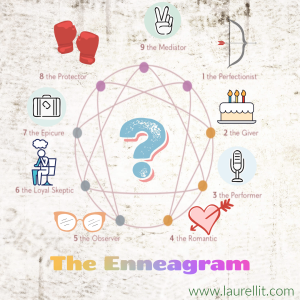
The nine personality types each have their own distinct set of motivations, needs, and fears, represented by a nine-pointed star and associated represented by a particular number.
The Nine Enneagram Personality Types Are:
Type 1 – The Perfectionist: A reformer who strives for excellence in all their endeavors. Analytical, self-critical, and moralistic.
Example: Atticus Finch from Harper Lee’s To Kill a Mockingbird – Atticus is a moral paragon who never wavers from his principles and is always striving to do the right thing.
Type 2 – The Giver: A generous and loving soul who puts other people’s needs before their own. Warm, affirming, and compassionate.
Example: Hagrid from J.K. Rowling’s Harry Potter. Though his actions are often misguided, Hagrid always operates out of kindness. His main desire is to help those whom he cares about.
Type 3 – The Performer: Ambitious and driven, these characters always strive for success and recognition. Image-conscious, goal-oriented, and competitive.
Example: Tony Stark from Marvel’s Iron Man is a self-made billionaire who pushes himself to the limit in pursuit of success.
Type 4 – The Artist: A sensitive and introspective type who values authenticity and depth. Creative, and prone to moodiness.
Example: Peeta Melark from Suzanne Collins’ The Hunger Games. Peeta appreciates beauty and truth, and his main concern is staying true to himself, rather than letting the Capitol turn him into a ruthless killer.
Type 5 – The Observer: A cerebral and independent type who is always looking for new ideas and ways of understanding the world. Analytical, curious, and often reserved.
Example: Sherlock Holmes from Sir Arthur Conan Doyle’s The Adventures of Sherlock Holmes. Holmes uses his sharp intellect to solve seemingly impossible mysteries.
Type 6 – The Loyal Skeptic: A responsible and diligent type who values security and stability. Loyal, practical, and sometimes anxious.
Example: Marilla Cuthbert from Lucy Maud Montgomery’s Anne of Green Gables. It takes Marilla a while to warm up, but once she’s on your side, she will never waver.
Type 7 – The Epicure: An upbeat and optimistic type who is always looking for new experiences and ways to have fun.
Example: Elle Woods from Legally Blonde. Elle is a fun-loving law student who never stops believing in herself, even when the odds are stacked against her.
Type 8 – The Protector: A powerful and assertive type who takes charge and leads the way. Decisive, bold, and often quite confrontational.
Example: Katniss Everdeen from Suzanne Collins’ The Hunger Games. Katniss is a brave and determined hunter who is willing to lay down her life for her family and friends.
Type 9 – The Mediator: A gentle and harmonious type who values balance and understanding. Self-effacing, tolerant, and easy-going.
Example: Bilbo Baggins from J.R.R. Tolkien’s The Hobbit. Bilbo is a mellow hobbit who loves peace and quiet.
Enneagram for Character Development
To use the Enneagram to develop your characters, start by understanding the basic characteristics of each type. Then you can explore the motivations, needs, and fears of specific characters to make them both authentic and believable.
For example, say your protagonist is a Performer (3). Achievers are driven by the need for recognition and success, so perhaps they’re determined to become a world-renowned scientist or to make a fortune in the stock market. The Performer’s fear of failure can be driven by a desire to prove themselves and not be dismissed as a “nobody.”
Enneagram for Conflict
Once you’ve created characters with realistic and believable motivations, use the Enneagram to create authentic interactions between them. Represent a variety of personality types to create misunderstandings, miscommunications, and conflict.
For example, a Loyal Skeptic (6) might be naturally drawn to a Giver (2), while an Observer (5) might be more likely to clash with a Performer (3). The Performer might be driven by their ambition and need for recognition, while the Observer might be suspicious of the Performer’s motivations and challenge their every move. A relationship like that, especially if it’s romantic, establishes a push/pull dynamic, giving your characters a compelling reason to interact.
Enneagram for Character Arcs
You can also use The Enneagram to develop character arcs. By understanding each character’s motivations, needs, and fears, you can let them change and grow throughout the story. For instance, your Performer might start off as arrogant and ambitious, but over the course of the story, become humbled and learn the importance of helping others.
The Enneagram is a powerful tool if you’re looking to craft deep, authentic characters. By using this system, you can gain insight into the motivations, strengths, and weaknesses of your characters, ultimately making them more emotionally resonant and complex.
For more in-depth information on using the Enneagram for character development & conflict, check out The Enneagram for Writers by Cara Putnam on Amazon.
Leave a Reply